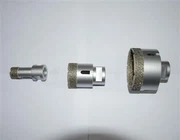
Factors Affecting The Efficiency And Life Of Diamond Saw Blade
Jun 09, 2023
The factors that affect the efficiency and life of diamond blade include sawing process parameters, diamond particle size, concentration, binder hardness and so on. According to the cutting energy, there are blade line speed, sawing concentration and feed speed.
First, sawing parameters
(1) Saw blade line speed: In actual work, the line speed of the diamond circular saw blade is limited by the equipment conditions, the quality of the saw blade and the nature of the sawn stone. In terms of the best service life and cutting efficiency of the saw blade, the linear speed of the saw blade should be selected according to the nature of different stones. When sawing granite, the saw blade line speed can be selected in the range of 25m ~ 35m/s. For granite with quartz content and difficulty in sawing, the limit of saw blade line speed is appropriate. In the production of granite tiles, the diamond circular saw blade used is small in diameter and the line speed can reach 35m/s.
(2) sawing depth: sawing depth is an important parameter involving diamond wear, effective sawing, saw blade stress and sawing stone properties. Generally speaking, when the linear speed of the diamond circular saw blade is relatively high, a small cutting depth should be selected. From the current technology, the depth of sawing diamond can be selected between 1mm and 10mm. When cutting granite blocks with a large diameter saw blade, the cutting depth can be controlled between 1mm and 2mm, and the feed speed should be reduced at the same time. When the linear speed of the diamond circular saw blade is large, the cutting depth should be selected. However, when the performance of the saw machine and the strength of the tool are allowed, the cutting concentration should be as large as possible to cut in order to improve the cutting efficiency. When there are requirements for machining surfaces, small depth cutting should be used.
(3) Feed speed: feed speed is the feed speed of the sawn stone. Its size affects the sawing rate, blade force and heat dissipation in the sawing area. Its value should be selected according to the nature of the sawn stone. Generally speaking, sawing soft stone, such as marble, can be appropriate to raise the feed speed, if the feed speed is too low, it is more conducive to lift the cutting rate. Sawing fine grained structure, relatively homogeneous granite, can be appropriate to raise the feed speed, if the feed speed is too low, the diamond blade is easy to be worn flat. However, when sawing granite with coarse grain structure and uneven hardness, the feed speed should be reduced, otherwise the saw blade vibration will lead to diamond fragmentation and reduce the sawing rate. The feed speed of sawing granite is generally selected in the range of 9m ~ 12m/min.
2. Other influencing factors
(1) Diamond size: the commonly used diamond size is in the range of 30/35 ~ 60/80. The harder the rock, the finer granularity should be selected. Because under the same pressure conditions, the finer the diamond, the sharper it is, which is conducive to cutting into the hard rock. In addition, generally large diameter saw blades require sawing efficiency, should choose a coarser particle size, such as 30/40, 40/50; The efficiency of sawing with small diameter blade is low, and the section of rock sawing is required to be smooth, and finer particle size should be selected, such as 50/60, 60/80.
(2) Head concentration: The so-called diamond concentration refers to the density of the diamond distribution in the working layer matrix (that is, the weight of the diamond contained in the unit area). The "Code" states that the concentration of 4.4 carats of diamond per cubic centimeter of working matrix is 100%, and the concentration of 3.3 carats of diamond is 75%. The volume concentration indicates how much diamond accounts for the volume of the lump, and specifies that the concentration is 100% when the volume of diamond accounts for 1/4 of the total volume. Increasing the diamond concentration is expected to extend the life of the saw blade, because increasing the concentration reduces the average cutting force on each diamond grain. However, increasing the depth will inevitably increase the cost of the saw blade, so there is an economic concentration, and the concentration increases with the increase of the Cheng cut rate.
(3) Hardness of the tool head bond: Generally speaking, the hardness of the bond, the stronger its wear resistance. Therefore, when sawing the abrasive rock, the hardness of the binder should be appropriate; When sawing soft rock, the hardness of the bond should be low; When sawing abrasive and hard rocks, the hardness of the bond should be moderate.
(4) Force effect, temperature effect and wear damage: diamond circular saw blade in the process of cutting stone, will be subjected to centrifugal force, sawing force, sawing heat and other alternating loads.
Factors Affecting The Efficiency And Life Of Diamond Saw Blade
Diamond saw blades are essential tools in the construction industry and are widely used for cutting different materials such as concrete, stone, asphalt, and ceramic. The performance of these tools depends on numerous factors, including the quality of the blade, the type of material being cut, the speed and pressure of the cutting process, and the cooling methods used. In this article, we will explore the various factors that affect the efficiency and life of diamond saw blades.
Quality Of The Blade
The quality of a diamond saw blade is one of the most critical factors that determine its efficiency and life. Low-quality blades may have inadequate diamonds or are not properly bonded, resulting in poor performance and a shorter lifespan. To ensure the quality of a blade, it is crucial to consider the diamond concentration, the bonding materials, and the manufacturing process.
Diamond Concentration
The concentration of diamonds in a saw blade determines the amount of diamond abrasive on its surface. A high diamond concentration means more diamond abrasive and a longer blade life. However, a blade with too much diamond can lead to inefficient cutting as the diamond particles become overcrowded. An ideal concentration of diamonds for a diamond saw blade is around 25% to 50%.
Bonding Materials
Bonding materials are used to hold the diamond abrasive in place and should be chosen carefully depending on the material being cut. Bonding materials can be made of metal, resin, or a combination of both. The quality of the bonding materials affects the blade's performance and its ability to withstand high speed and pressure during the cutting process.
Manufacturing Process
The manufacturing process of a diamond saw blade is critical to its quality and lifespan. The process involves mixing diamonds and bonding materials, pressing the mixture into a mold, and heating it to create a solid blade. A high-quality saw blade goes through a rigorous and precise manufacturing process that ensures the diamonds are evenly distributed and securely bonded.
Type Of Material Being Cut
Different materials require different types of diamond saw blades. The hardness, density, and abrasiveness of the material being cut affect the blade's performance and lifespan. For example, cutting tougher materials such as granite or quartz requires diamond blades with a higher concentration of diamonds, while softer materials such as asphalt or green concrete require a lower concentration of diamonds.
Speed And Pressure Of The Cutting Process
The speed and pressure at which the diamond saw blade cuts the material also affect its efficiency and lifespan. High speeds can overheat the blade and cause it to wear out quickly, while low speeds can lead to a slow and inefficient cutting process. The amount of pressure applied also affects the blade's lifespan, with excessive pressure leading to faster wear and tear.
Cooling Methods
Cooling methods are used to reduce the heat generated during the cutting process and prolong the lifespan of the diamond saw blade. Wet cutting, which involves water or other coolants, is the most efficient way to cool the blade and can significantly extend its life. Dry cutting, on the other hand, creates more heat and can lead to faster wear and tear.
In conclusion, the efficiency and lifespan of diamond saw blades depend on various factors, including the quality of the blade, the type of material being cut, the speed and pressure of the cutting process, and the cooling methods used. By considering these factors and choosing the right diamond saw blade for the job, contractors can ensure a more efficient and cost-effective cutting process.