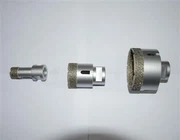
Discussion On The Selection Principles Of Milling Cutters
Jun 18, 2023
1. Selection of milling cutter diameter
The selection of milling cutter diameter varies greatly depending on different products and production batches. The selection of tool diameter mainly depends on the specifications of the equipment and the processing size of the workpiece.
Face milling cutter
When selecting the diameter of the face milling cutter, the main consideration is that the power required by the tool should be within the power range of the machine tool, or it can be selected based on the diameter of the machine tool spindle.
The diameter of the face milling cutter can be selected according to D=1.5d (D is the spindle diameter).
In batch production, the tool diameter can also be selected based on 1.6 times the cutting width of the workpiece.
End milling cutter
The diameter of the end mill should be selected according to the requirements of the workpiece processing size to ensure that the required power of the tool is within the rated power range of the machine tool.
If it is a small diameter end mill, the main consideration should be whether the rotation of the machine tool can reach the cutting speed of the tool (60m/min).
Gear shaper cutter
The diameter and width of the slot milling cutter should be selected based on the size of the workpiece being processed, and its cutting power should be within the allowable power range of the machine tool.
2. Selection of milling cutter blades
Use a grinding blade. This type of blade has good dimensional accuracy, so milling is a tool with high cutting edge positioning accuracy, which can achieve good machining accuracy and surface roughness.
b. For rough machining, use sheet pressing to reduce processing costs.
The dimensional accuracy and sharpness of the pressing plate are worse than those of the grinding plate, but the edge strength of the pressing plate is better, it is resistant to impact during rough machining, and can withstand large cutting depths and large feed rates.
c. Sharp blades with large front corners can be used for milling viscous materials such as stainless steel. Through the cutting action of the sharp blade, the friction between the blade and the workpiece material is reduced, and the chips can leave the front end of the blade faster.
3. Selection of milling cutter body
a. Firstly, when selecting a milling cutter, the number of teeth must be considered.
The size of the tooth pitch determines the number of cutting teeth that simultaneously participate in the milling process, affecting the smoothness of cutting and the requirements for the cutting speed of the machine tool.
Coarse tooth milling cutters are mostly used for rough machining because they have large chip removal slots.
At the same feed speed, the cutting load per tooth of the coarse tooth milling cutter is greater than that of the dense tooth milling cutter.
b. During precision milling, the cutting depth is relatively shallow, usually ranging from 0.25 to 0.64mm. It is recommended to use a dense tooth milling cutter.
c. Rough milling has high strength and excessive cutting force, which can cause low stiffness machine tool chatter.
This vibration can cause the hard alloy blade to fracture, thereby shortening the tool life. The use of coarse tooth milling cutters can reduce the demand for machine tool power.
So. When the spindle hole size is small (such as R8, 30 #, 40 # taper holes), a coarse tooth milling cutter can be used for effective milling.
Discussion On The Selection Principles Of Milling Cutters
When it comes to the selection of milling cutters, there are several principles that need to be considered in order to choose the right cutter for the job. As a machine shop owner or an individual who regularly works on milling machines, it is important to understand these principles and apply them when selecting the right cutter for your specific application.
Principle #1: Material to be machinedThe first principle to consider when selecting a milling cutter is the material to be machined. Different materials have different machining properties, and therefore require different types of milling cutters to achieve optimal results. For example, when working with soft materials such as aluminum or brass, a high-speed steel (HSS) cutter will suffice, whereas when working with hard materials such as titanium or stainless steel, a carbide cutter will be required.
Principle #2: Operation typeThe second principle to consider is the type of milling operation that will be performed. There are several types of milling operations including contouring, facing, slotting, and more. Each of these operations requires a different type of cutter to achieve the desired results. For instance, if slotting is to be performed, a T-slot cutter will be required, whereas if contouring is to be performed, a ball end mill will be more suitable.
Principle #3: Machine specificationsAnother principle to keep in mind is the specifications of the milling machine being used. The size and horsepower of the machine, as well as the spindle speed and feed rate, will all impact the choice of milling cutter. For example, a smaller machine with limited horsepower will require a smaller and lighter cutter, whereas a larger, more powerful machine will be able to handle larger and heavier cutters.
Principle #4: Cutting speed and feed rateThe cutting speed and feed rate also play a crucial role in the selection of milling cutters. Cutting speed refers to the speed at which the cutter rotates, while the feed rate refers to the rate at which the cutter moves through the material being machined. The cutting speed and feed rate should be optimized to achieve maximum efficiency and accuracy, which also determines the type of cutter to be used.
Principle #5: Tool material and coatingFinally, the material and coating of the milling cutter should also be taken into consideration. The material of the cutter affects its durability and efficiency, while the coating affects its performance and lifespan. Carbide and HSS are the most commonly used materials for milling cutters, and they can be coated with various materials such as titanium nitride (TiN) or diamond-like carbon (DLC).
In conclusion, the selection of milling cutters involves a thorough consideration of the material to be machined, the type of milling operation, the machine specifications, the cutting speed and feed rate, as well as the tool material and coating. By applying these principles, machine shop owners and individuals can make informed decisions and achieve optimal results in their milling operations.